
Disclaimer: This article is informational only. It is not intended to be and is not legal advice.
Every year, I see people on social media promoting Book Exchanges. It’s almost always the same “send 1 book, get up to 36 books in exchange,” and every year I wish I could explain to everyone that it’s a pyramid scheme. Given that I can’t possibly respond to every one of the hundreds of posts that I see (not to mention the ones that I don’t see), the next best thing is to write an article and hope that it reaches the right people.
What’s the Big Deal?
If you have inadvertently participated in a pyramid exchange, please don’t feel bad about it! It’s very easy to miss the red flags, especially since it’s such a commonly promoted exchange.
This type of exchange seems low risk because you only have to send one item. Receiving even one book makes participants feel like they came out even, and anything beyond that feels like profit.
On the other side, participants who sent a book but don’t receive one are only out one book, which doesn’t seem like a big deal. It’s easy to see why people participate.
However, a pyramid exchange is more complex than it appears; mathematically, it’s impossible for everyone to receive 36 books even with perfect participation. Additionally, pyramid schemes are illegal in the U.S., even if it’s a book exchange and not cash.
So let’s explore why pyramid exchanges don’t work and why you should think twice before participating.
How does this type of exchange work?
The chain starts with a message similar to this one:
I’m looking for people to participate in a huge book exchange.
All you have to do is:
(1) have an Amazon book link in your bio,
(2) send ONE book to another person (I’ll send their Instagram bio to you in a private message).
You will receive a maximum of 36 books back to you, to keep! If you’re interested in taking part, reply to this message with “IN.”
When you opt in, the Poster will send you two links: (1) the Receiver’s wishlist so you can send your one book to them, and (2) the Poster’s wishlist which you will pass on to your own recruits.
The six people that you recruit will each send one book to the Poster.
Where do get your own 36 books from? Not from your own six friends, but in theory from your six friends’ friends.
If (and that’s a big IF) all six of your recruits can recruit six more people each (a total of 36 people) then all of those 36 people will be sending their one book to you.
In the same way, your six recruits can only get 36 books of they recruit six people who each recruit another six people who all follow through on the commitment (a total of 216 people).
Can you see how quickly this exchange can fizzle out? This growth is exponential and unsustainable.
Here’s a visual of how quickly the number of people who need to participate becomes impossible:
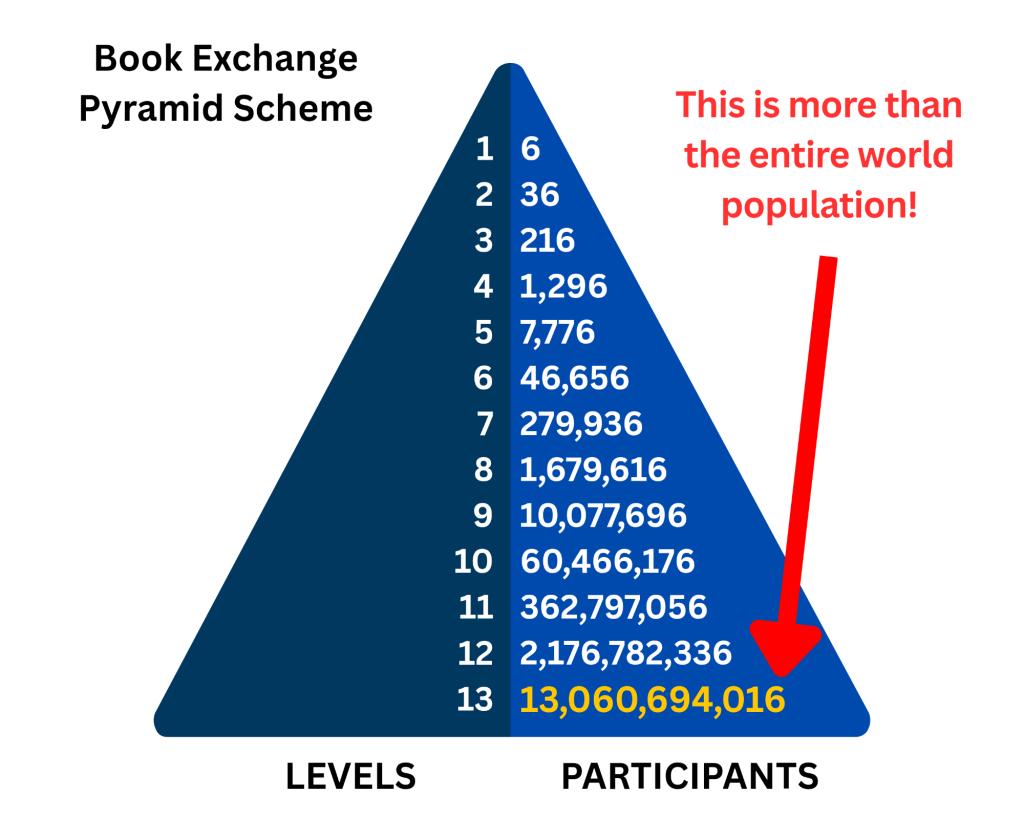
By level 10, the number of participants needed will be greater than the entire United States of America population.
By level 13, the number of participants needed will be greater than the entire world population.
If the chain falls apart at level 5, only 43 people get their books, while 1512 don’t (again, 3% vs 97%).
I know that sounds insane, but that’s how a pyramid scheme works (or, how it fails to work!)
Ultimately, a very small percentage of people will benefit from these exchanges by taking advantage of newer participants.
Who is it really hurting?
Further down the chain, it becomes harder for new recruits to find people who haven’t already participated, especially if they don’t have as many followers as the person who started it.
The chain will start to fizzle out, meaning participants will stop receiving books.
Even if every single person sends out one book, it is mathematically impossible for everyone to receive 36 books.
You might say, “If I don’t get anything then I’m only out one book, so it’s not a big deal.”
Well, by participating and recruiting others it quickly becomes about more than you—it could be dozens, hundreds, thousands, or more people who end up sending out a book and don’t get anything in exchange.
How Many People Don’t Receive Books?
To put this mathematically, I’ll take an excellent example from an article by Craig Haley for This Nonsense.
Let’s assume that the pyramid falls apart by level 10, which means that levels 9 and 10 will not receive books. Haley did the math for us:
Levels 1 to 8 = is 1 + 6 + 36 + 216 + 1296 + 7,776 + 46,656 + 279,936 = 335,923 kids get their books.
Levels 9 and 10 = 1,679,616 + 10,077,696 = 11,757,312 kids do not get their books.
End result, approximately 3% of kids will get books and 97% will not.
Let’s take a moment to process those numbers.
3% of participants get books and 97% get none.
If the chain falls apart at level 5, even if everyone sends out one book, only 43 people get their books while 1512 won’t receive anything (again, 3% vs 97%).
I know that sounds insane, but that’s how a pyramid scheme works (or, how it fails to work!)
Ultimately, a very small percentage of people will benefit from these exchanges by taking advantage of newer participants.
Is this type of exchange ethical?
Do you think it’s ethical to promote an exchange that doesn’t guarantee that all participants will receive something?
Is it ethical to benefit from an exchange even if it comes at the cost of most other participants not receiving anything?
Is it ethical to promote the idea that participants will receive “up to 36 books” even though that’s a highly unlikely outcome?
Is it taking advantage of people to start or continue a chain, knowing that the people at the top are likely to receive way more books than those at the bottom?
Is this type of exchange legal?
Even if you don’t care about the ethical issues, you should be aware that this kind of exchange is illegal.
USPS Statement
“There’s at least one problem with chain letters. They’re illegal if they request money or other items of value and promise a substantial return to the participants.”
Better Business Bureau
“If you love to read, you’d jump at the chance to receive dozens of books in the mail. But think twice before you respond to a social media post about a suspiciously generous book exchange. It’s really a pyramid scheme!”
It may be unlikely to get into trouble for a book exchange but that doesn’t make it right. I recommend staying away from these pyramid schemes and choosing a different way to spread holiday cheer this year.
A Note on Privacy and Safety Concerns
I did not address privacy concerns in this article, especially since nowadays some of these exchanges are done through websites like Amazon, which allows you to send a gift from someone’s wish list without ever seeing their home address. However, if you do choose to participate in exchanges, be wary of sharing your personal information (address, full name, etc.) with others.
Alternative Options
This doesn’t have to be the end of all exchanges though—there are great alternatives, like a one-to-one exchange between trusted friends, an exchange which typically has more oversight by a coordinator and almost guarantees that everyone will get at least something. In the case that a partner falls through, it’s common practice for people to be rematched so they will receive something. If you can meet up with friends IRL, in person book swap could be even better.
Generally, a one to one type of exchange works well. It’s important thing is to watch out for exchanges that promise substantial returns; chances are, those are also pyramid schemes.
Sources / Additional Reading
https://www.investor.gov/protect-your-investments/fraud/types-fraud/pyramid-schemes
https://www.ftc.gov/sites/default/files/documents/public_comments/trade-regulation-rule-disclosure-requirements-and-prohibitions-concerning-business-opportunities-ftc.r511993-00009%C2%A0/00009-57282.pdf
https://about.usps.com/publications/pub300a/pub300a_v04_revision_072019_tech_007.htmhttps://www.investor.gov/protect-your-investments/fraud/types-fraud/pyramid-schemes
https://www.bbb.org/article/scams/26442-bbb-scam-alert-this-social-media-book-exchange-is-really-a-pyramid-schemehttps://www.investor.gov/protect-your-investments/fraud/types-fraud/pyramid-schemes
https://www.businessinsider.com/facebook-book-exchange-scam-2016-4
https://www.snopes.com/fact-check/chain-linked/https://www.investor.gov/protect-your-investments/fraud/types-fraud/pyramid-schemes
https://lithub.com/that-book-exchange-making-the-rounds-on-instagram-again-isnt-what-it-seems/
https://www.thatsnonsense.com/the-36-books-for-1-book-exchange-pyramid-scheme-debunked/




 Alicia's Realm
Leave a comment